



Violence against Christians in Nigeria remains a major concern for the United States, senior State Department officials told Congress on 12 November 2026, as Washington pressed for stronger protection of vulnerable communities and accountability for attacks. Nigeria disputes claims that its authorities systematically persecute Christians and says terrorism and other armed violence threaten citizens of different religions.
Assistant Secretary of State for African Affairs Frank Garcia said the US was working with Nigerian officials to address attacks and bring perpetrators to justice. The remarks were reported by Reuters following a House Foreign Affairs Subcommittee on Africa hearing chaired by Representative Chris Smith.
- Why the US is raising violence against Christians in Nigeria
- What Nigerian authorities say about the crisis
- Why the Middle Belt is central to the debate
Show More (1)Show Less
Why the US is raising violence against Christians in Nigeria
The hearing examined the situation one year after Washington redesignated Nigeria a Country of Particular Concern under US religious-freedom law. The designation reflects the American government’s assessment of severe religious-freedom problems; it is not a court finding that every attack in Nigeria is religiously motivated.
In his written testimony, Garcia described engagement with Nigerian authorities through a joint working group and said violence remained a serious challenge. The congressional hearing also examined whether announced security measures were improving conditions for communities facing attacks.
Assistant Secretary Riley Barnes acknowledged steps including recruitment of police officers, deployment of forest guards and more arrests and prosecutions. However, according to Reuters, he told lawmakers that these measures had not yet translated into greater safety for Christian communities in Nigeria’s Middle Belt.
What Nigerian authorities say about the crisis
Nigeria’s government rejects the suggestion that it tolerates a campaign of religious persecution. Officials describe the wider crisis as a combination of Islamist insurgency, banditry, kidnapping and clashes involving farmers and herders. They say Christians and Muslims have both been killed or displaced and that security cooperation must respect Nigeria’s sovereignty.
That position differs from the emphasis placed by several US lawmakers on attacks targeting Christian villages and worshippers. The competing descriptions should not obscure the documented insecurity or the need to establish the perpetrators and motives of individual incidents through credible investigations.
Why the Middle Belt is central to the debate
The Middle Belt includes communities where religious identity, ethnicity, access to farmland and grazing routes, and local political disputes can overlap. Some attacks involve explicit religious targeting, while others are connected to criminality or resource disputes. A responsible assessment requires evidence specific to each incident rather than treating every act of violence as having one cause.
At the hearing, lawmakers drew attention to attacks in Plateau State and questioned whether Nigerian security agencies could respond quickly enough to warnings. Their concerns focused on the protection of civilians and the ability to investigate and prosecute those responsible.
Security cooperation and accountability
The United States has urged Nigeria to strengthen early-warning systems, protect threatened settlements and pursue prosecutions. Nigeria has said it welcomes assistance against armed groups while maintaining control over its own security operations. Those positions leave room for cooperation, although the governments disagree over aspects of how the violence should be characterised.
The next test will be whether commitments result in fewer attacks, quicker emergency responses and credible legal action. Numbers of personnel deployed or arrests announced do not by themselves show whether families are safer, particularly where communities remain vulnerable to repeated raids.
For affected Nigerians, the immediate priorities extend beyond diplomatic disagreements: protecting lives, restoring access to farms and schools, supporting displaced families and ensuring victims can report crimes without fear. Reporting on violence against Christians in Nigeria must also recognise attacks on other communities without minimising cases in which religion is a documented factor.
The November congressional hearing was part of continuing US scrutiny of Nigeria’s security response. No claim about a new sanction or a final policy decision is made here; the statements cited describe the positions presented at that hearing.
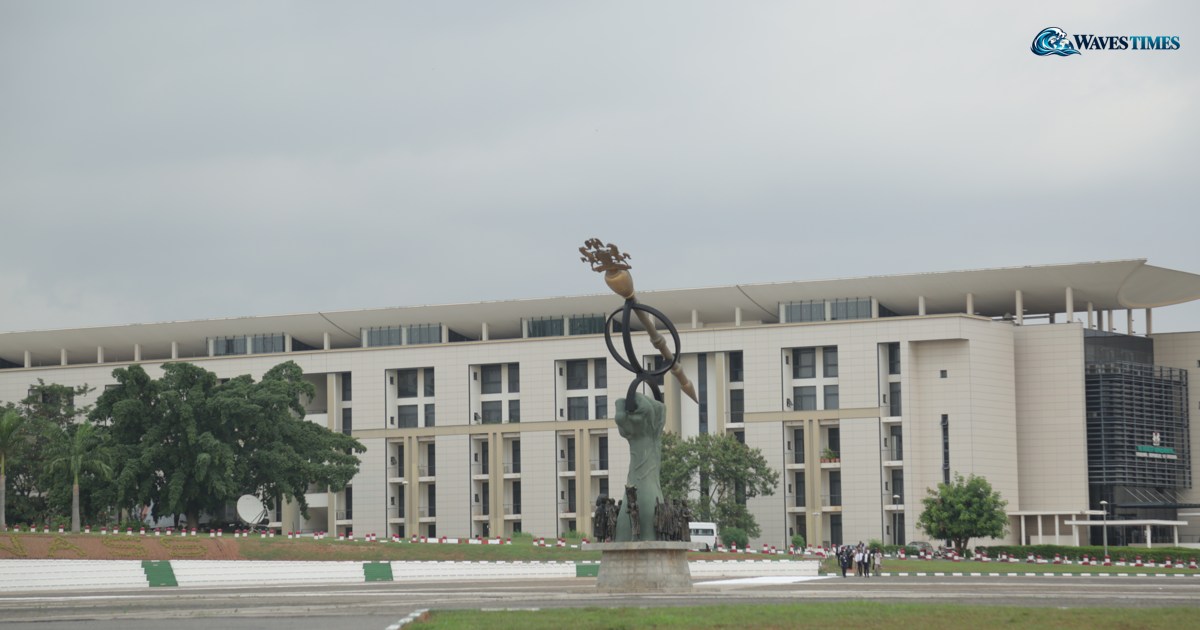
File photo: Nigeria’s National Assembly complex in Abuja. Kabusa16 / Wikimedia Commons, CC BY-SA 4.0. Cropped and Waves Times logo added.
Discover more from Waves Times
Subscribe to get the latest posts sent to your email.