

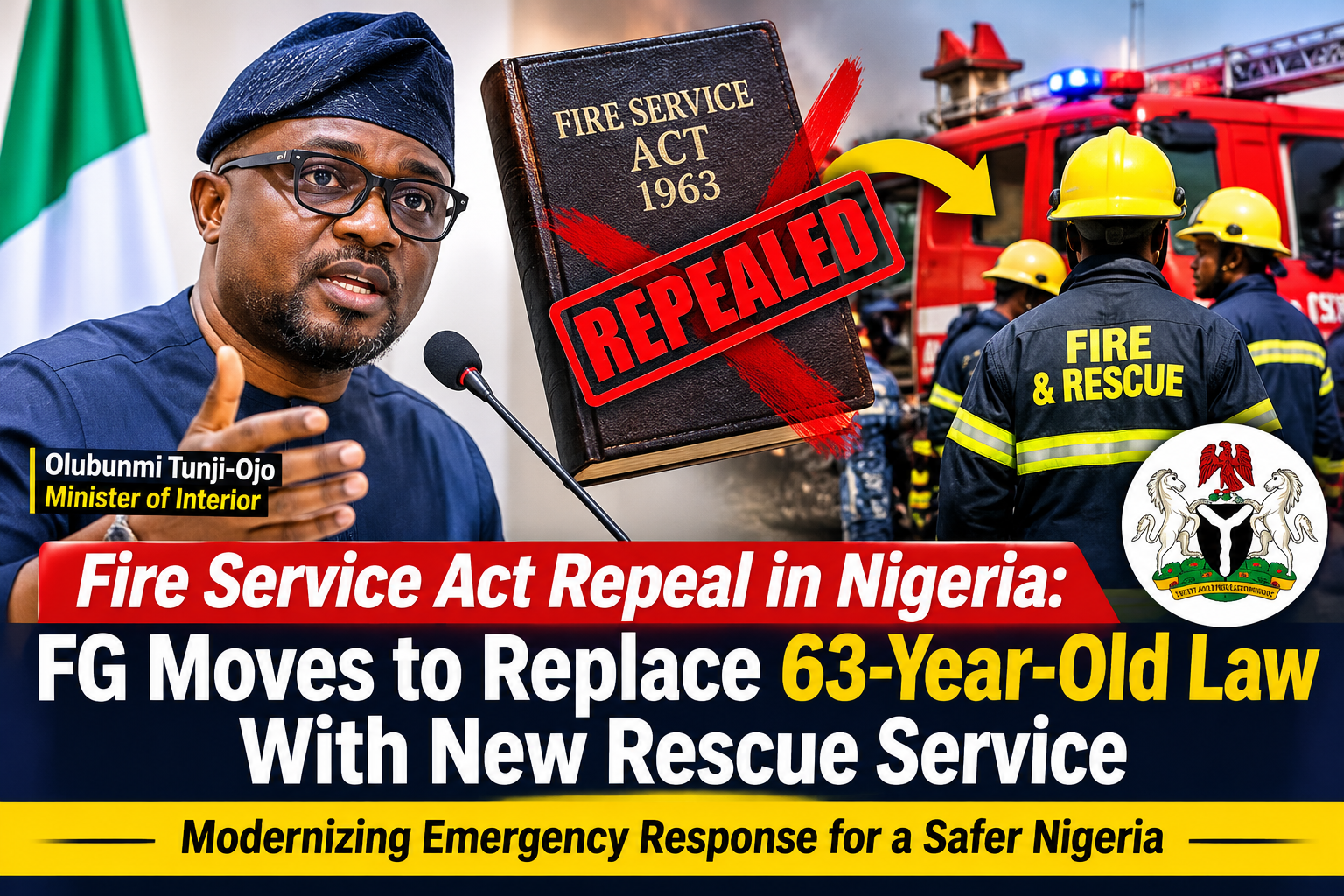

The Federal Government is pushing for a major transformation of Nigeria’s emergency response system through plans to replace the country’s 63-year-old Fire Service Act with new legislation designed to expand the responsibilities of the Federal Fire Service.
Minister of Interior, Olubunmi Tunji-Ojo, says the existing law no longer reflects the demands of modern emergency management, making legislative reform necessary to improve the country’s capacity to respond to fires, road accidents, floods and other disasters.
The proposed reform is expected to transform the Federal Fire Service into a more comprehensive Federal Fire and Rescue Service, with responsibilities extending beyond conventional firefighting. The minister disclosed the government’s position during the 2026 National Fire Safety Week in Abuja, where he outlined the administration’s vision for a modern emergency response institution.
Why the Federal Government Wants to Repeal the 1963 Fire Service Act
The existing Fire Service Act was introduced in 1963, at a time when the responsibilities and operational demands of fire services were considerably different from what they are today. More than six decades later, Nigeria faces a wider range of emergencies requiring specialised equipment, trained personnel and coordinated rescue operations.
According to Tunji-Ojo, the outdated legislation has restricted the Federal Fire Service from fully carrying out certain responsibilities because its legal authority does not adequately cover the demands of modern emergency response. The minister believes that changing the law is essential to giving the agency the necessary powers to perform its expanded duties. He maintained that government institutions must operate within the authority provided by law, regardless of how important their intended actions might be.
The proposed legislation is therefore intended to provide a stronger legal foundation for the transformation of the service.
New Fire and Rescue Service to Handle More Than Fire Emergencies
One of the biggest changes expected under the proposed Fire Service Act repeal in Nigeria is the expansion of the agency’s responsibilities.Rather than concentrating primarily on putting out fires, the proposed Federal Fire and Rescue Service would take on a broader emergency management role.
Its proposed responsibilities include:
- Emergency Medical Services: Providing immediate medical assistance and first aid during emergencies.
- Search and Rescue Operations: Responding to incidents involving collapsed buildings, trapped victims and other rescue situations.
- Flood Emergency Response: Supporting rescue operations during flooding and other water-related disasters.
- Hazardous Materials Management: Responding to incidents involving dangerous chemicals, toxic gases and other hazardous substances.
- Road Accident Response: Assisting in rescue operations following serious road accidents.
- Fire Prevention and Inspection: Strengthening inspections and enforcing fire safety standards in public and private buildings.
- Disaster Management: Supporting emergency operations during natural and human-induced disasters.
These expanded responsibilities are expected to position the agency as a major first responder during emergencies across the country.
Tunji-Ojo Calls for Better Fire Safety Education in Schools
Beyond changing the legislation, the Interior Minister wants fire prevention and basic emergency response knowledge to become part of everyday education in Nigeria. He advocated the introduction of basic rescue techniques and lifesaving skills into school curricula at different educational levels. The proposal is aimed at equipping students with practical knowledge that could help them respond appropriately when emergencies occur. Such training could include basic first aid, emergency awareness and cardiopulmonary resuscitation (CPR).
The minister also called for stronger fire safety inspections and the deployment of trained fire marshals across communities to improve compliance with safety regulations. The broader objective is to encourage a culture where preventing emergencies and knowing how to respond to them become shared responsibilities.
National Fire Academy in Abuja Reaches 85% Completion
As part of efforts to strengthen the country’s firefighting and rescue capabilities, the Federal Government is also investing in specialised training infrastructure. Tunji-Ojo disclosed that the National Fire Academy in Sheda, Kwali Area Council of the Federal Capital Territory, had reached approximately 85 per cent completion. The facility occupies about 23 hectares and is expected to accommodate more than 3,000 trainees.
Upon completion, the academy will feature:
- Modern firefighting training facilities.
- Drill towers and specialised training centres.
- Classrooms and a library.
- A health centre.
- Hostel accommodation.
- Solar-powered infrastructure.
The academy is expected to improve professional training and prepare personnel for the more demanding responsibilities envisioned under the proposed reforms. According to the Ministry of Information, the facility is expected to be ready by the end of 2026.
Federal Fire Service Expands to 18 Commands
The proposed legislative reform is also coming alongside administrative changes within the Federal Fire Service. According to the Interior Minister, the number of Federal Fire Service commands has increased from six to 18. This expansion is expected to improve the agency’s administrative reach and create more opportunities for personnel to advance within the organisation. The government has also highlighted improvements in personnel welfare, including the approval of risk allowances and other entitlements.
Additionally, the minister disclosed that approximately 5,000 candidates had reached the final stages of the latest recruitment exercise, which involved documentation, drug testing and deployment procedures. These developments form part of the government’s broader efforts to improve the operational capacity of the service.
What the Proposed Fire Service Act Means for Nigerians
If successfully enacted, the proposed legislation could significantly change how emergency situations are handled in Nigeria.
Currently, emergency response often requires coordination between different agencies, depending on the nature of an incident.
A broader mandate for the Federal Fire and Rescue Service could strengthen its involvement in incidents that require specialised rescue operations.
For ordinary Nigerians, some potential benefits include:
- Faster Emergency Response: A more capable and properly equipped service could improve response during fires, accidents and other emergencies.
- Improved Rescue Operations: People trapped in collapsed structures, flooded communities or other dangerous situations could benefit from specialised rescue personnel.
- Better Fire Prevention: Stronger inspections and enforcement could encourage property owners and businesses to comply with established fire safety standards.
- Increased Public Awareness: Introducing lifesaving skills into schools could help young Nigerians understand how to respond appropriately to emergencies.
However, achieving these objectives will depend on adequate funding, modern equipment, professional training and effective coordination with state and local emergency agencies.
Has the New Fire and Rescue Service Law Been Passed?
Despite the government’s announcement, the proposed reform should not yet be confused with an enacted law.
The Interior Minister has outlined the government’s plan to replace the existing legislation, while the proposed framework is intended to establish the Federal Fire and Rescue Service.
As of November 4, 2026, the available official announcement confirms the government’s commitment to the reform but does not establish that the new legislation has received presidential assent. The legislative process and the eventual implementation of the proposed changes will determine when the expanded responsibilities can formally take effect.
Nigerians will therefore be watching closely for further developments concerning the bill and its progress through the legislative process.
Discover more from Waves Times
Subscribe to get the latest posts sent to your email.