
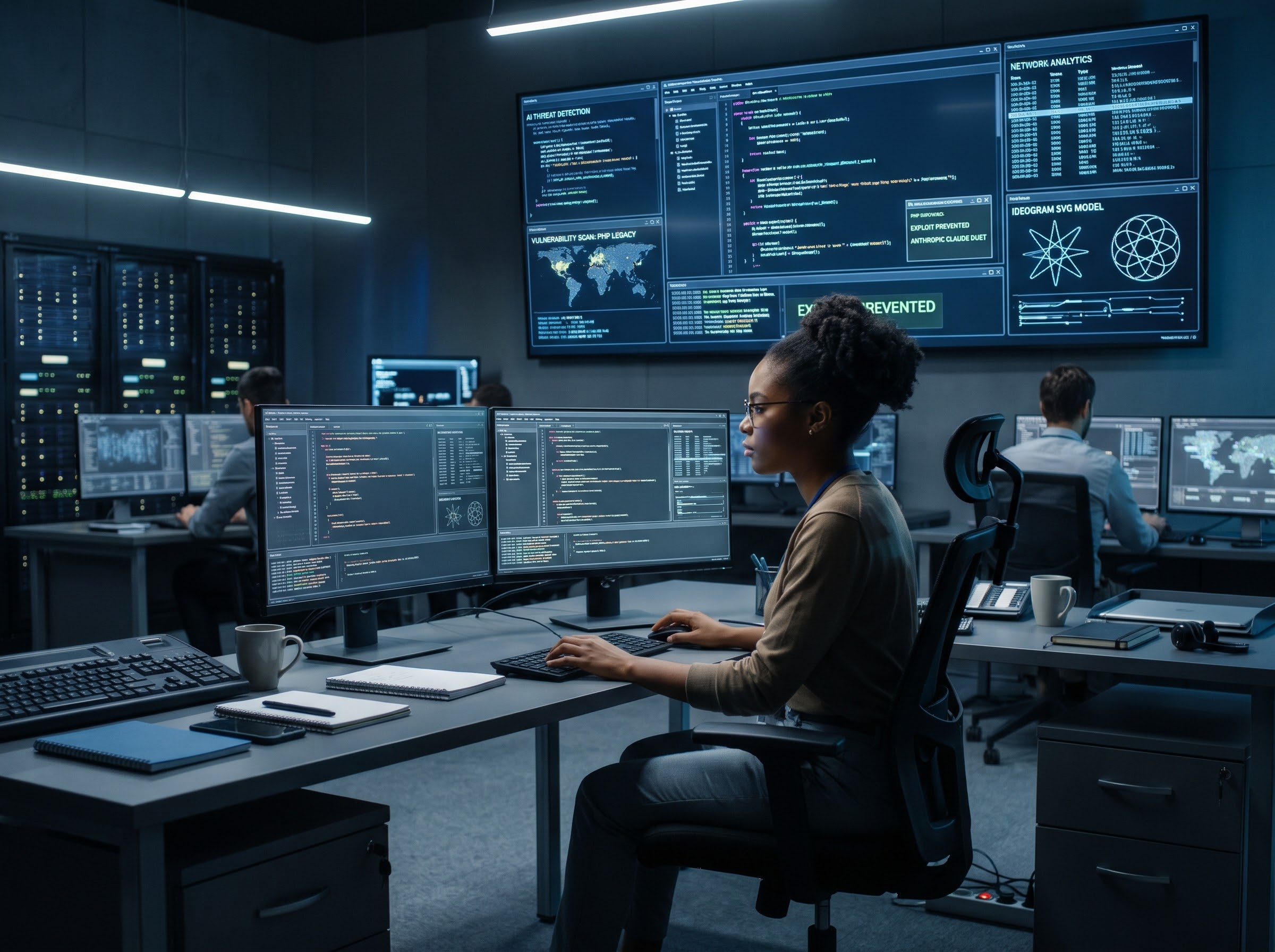

The tech world is currently witnessing unprecedented AI cybersecurity advancements that are actively reshaping how developers, designers, and security professionals operate. Recent developments have introduced massive leaps in artificial intelligence capabilities, directly impacting digital defense mechanisms and creative workflows. From OpenAI leveraging its newest architecture to expose legacy code flaws, to Anthropic releasing a highly anticipated dual-action model, the industry is moving at breakneck speed.
Furthermore, visual AI is catching up with structural coding thanks to Ideogram’s latest vector release. These rapid innovations are forcing tech ecosystems to adapt quickly to maintain security and competitive advantages.
How AI Cybersecurity Advancements Are Exposing PHP Flaws
OpenAI’s latest iteration, GPT-5.6 Soul, has demonstrated remarkable analytical depth by uncovering deep-rooted vulnerabilities within legacy PHP architecture. These long-standing security gaps have existed undetected for years, leaving countless web servers potentially exposed to targeted exploits.
- By utilizing highly advanced pattern recognition, the model did not just flag the errors; it provided cybersecurity experts with precise, ready-to-deploy patching protocols.
- The AI model scanned decades-old open-source repositories to identify hidden zero-day threats.
- Developers are now rushing to implement the automated security patches generated by the system.
This marks a major shift from manual security audits to AI-driven proactive defense strategies.
Anthropic’s Claude Duet and Ideogram’s Vector Innovation
Beyond digital defense, the landscape of generative models has expanded with Anthropic officially launching Claude Duet. This unique system is specifically engineered to handle multi-threaded conversational logic and complex reasoning simultaneously, making it a powerhouse for enterprise collaboration.
Meanwhile, Ideogram has revolutionized the graphic design space by releasing an entirely editable vector SVG model. Designers can now generate scalable graphics that can be instantly modified in traditional vector software without any loss of resolution or quality.
The combination of these releases highlights a major leap forward for digital creators and engineers alike. As language models secure the backend and generative visual models perfect the frontend, the integration of artificial intelligence into everyday professional workflows has never been more seamless.
Discover more from Waves Times
Subscribe to get the latest posts sent to your email.